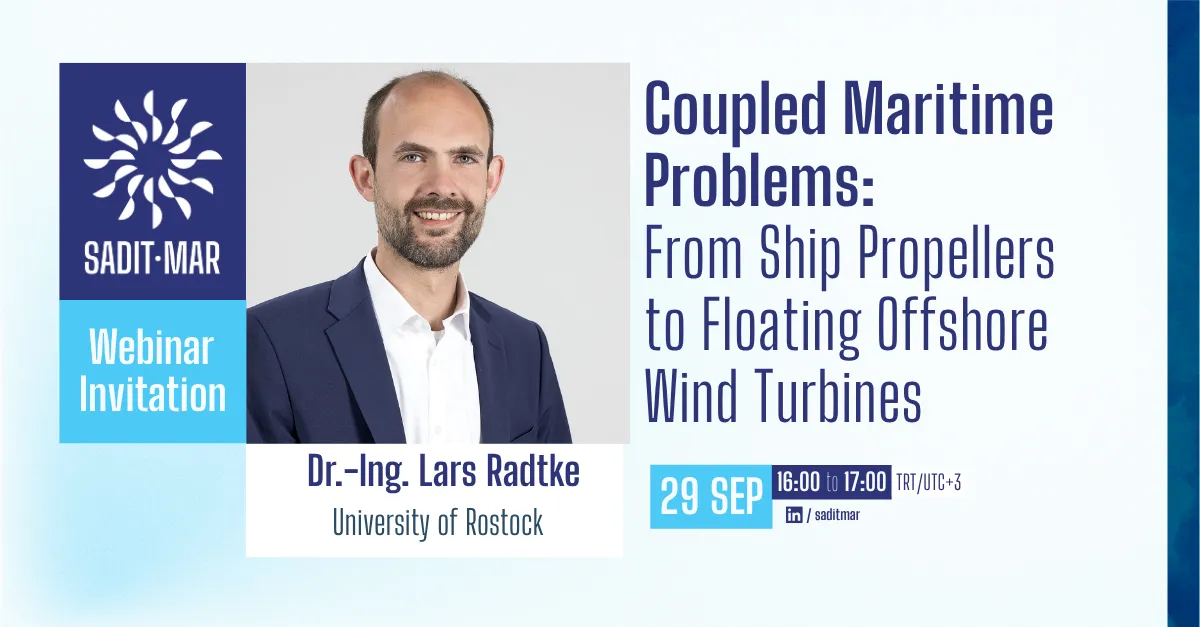
Coupled problems, in particular fluid-structure interaction (FSI) problems, frequently arise in maritime applications. Partitioned solution approaches allow reuse of existing software specialized for each subproblem. To predict the acoustic signature of ship propellers, for example, the two-field FSI problem must incorporate a cavitation model and be coupled to an acoustic solver. Using a boundary element method, the need for remeshing, mesh morphing, or mesh snapping is completely avoided. To accurately predict the dynamic behavior of floating offshore wind turbines, a structural problem must be coupled to a two-phase flow problem describing the aerodynamics around the turbine blades and the hydrodynamics around the floating platform. In this application, the complex structure demands dedicated finite element solvers that provide effective element types to discretize the platform (shell elements) as well as the mooring lines (cable elements).
Lars Radtke is acting head of the Chair of Structural Mechanics at the University of Rostock, in the Faculty of Mechanical Engineering and Marine Technologies, a position he has held since March 2025. He studied General Engineering Science and Theoretical Mechanical Engineering at Hamburg University of Technology, where he received his doctorate with distinction in 2019 for a partitioned solution approach to fluid-structure interaction in the arterial system, and served as senior engineer in the group for Numerical Structural Analysis with Applications in Ship Technology until 2025. His research covers coupled multi-field problems, shape and topology optimization, fictitious domain and immersed boundary methods, and fatigue crack growth, with applications in biomechanics, maritime technology, and renewable energy. He has published more than 55 scientific contributions and is an associate editor of Ships and Offshore Structures.
📆 September 29, 2026 🕔 16:00 to 17:00 (TRT/UTC+3)
About SADIT-MAR
SADIT-MAR (Safe Digital Transformation in the Maritime Industry) is a global academic network advancing safe, inclusive, and sustainable digital transformation across the maritime sector. Initially established and funded by Lloyd's Register Foundation, it unites six leading institutions across four continents. Through research on maritime safety, cyber resilience, autonomous systems, and digital risk management, along with international conferences, workshops, and training programs, the network builds expertise and shares knowledge across borders, working with industry, regulators, and policymakers to guide safe digital transformation worldwide.